
When hailstorms roll through Texas or Colorado’s infamous “Hail Alley,” the difference between a roof that survives and a roof that needs a full tear-off often comes down to material science. As a manufacturer that spends every production cycle engineering stone coated metal roofing hail resistance into our panels, we’ve watched this roofing system get pounded by golf-ball-sized ice — and walk away with nothing more than a few cosmetic marks. That’s why contractors, insurance adjusters, and increasingly homeowners themselves are asking for stone coated metal roofing by name after severe weather season.
Why Hail Is the Roofing Industry’s Most Expensive Problem
Hail is one of the leading causes of roof replacement claims in the United States. Unlike wind or rain, hail attacks a roof’s surface directly — cracking asphalt shingles, shattering clay and concrete tiles, and stripping the protective granules that shingles rely on to block UV rays. Once granule loss happens, the clock on a shingle roof’s remaining lifespan starts ticking much faster, even if the damage isn’t visible from the ground.
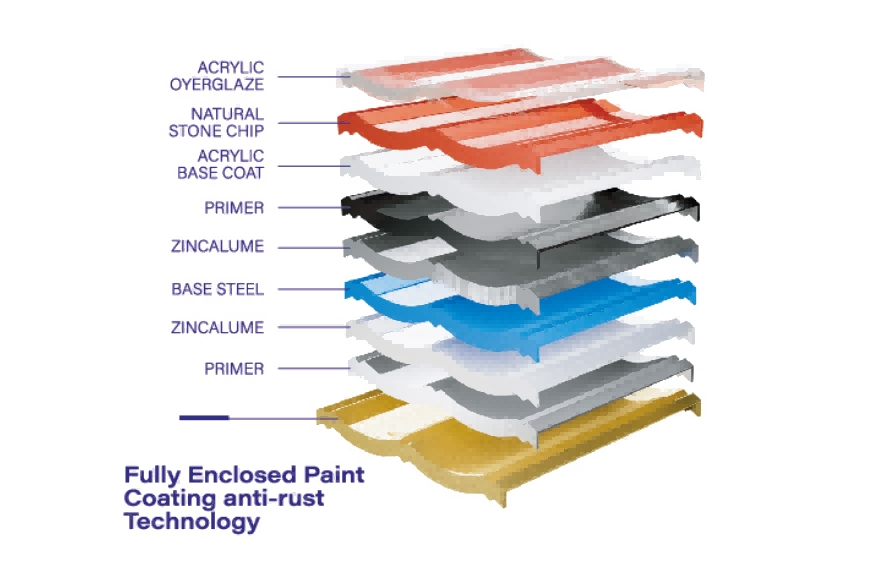
The Anatomy of Strength: Dual-Layer Hardness That Absorbs Violent Blows
This is where the physics of stone coated metal roofing change the equation entirely. The exceptional hail resistance of Hori Roofing tiles comes from a highly specialized, dual-layer material composition that combines the structural rigidity of metal with the natural abrasive hardness of stone.
1. The Core Armor: High-Tensile Galvalume Steel
The structural backbone of every tile is premium Galvalume steel (an aluminum-zinc alloy coated steel sheet, typically 26- or 29-gauge, with a steel gauge range of 0.40mm–0.50mm across our product line). Unlike brittle clay, concrete, or slate, steel possesses extreme tensile hardness coupled with natural material elasticity. When a massive hailstone strikes the roof, a brittle tile shatters because it cannot deform or absorb the kinetic energy. Our high-grade steel core behaves like armor plating — it flexes slightly and distributes the kinetic energy across the panel instead of letting it concentrate at a single point, absorbing and dissipating the impact without fracturing, puncturing, or breaking, keeping the structural seal of your building 100% secure.
2. The Surface Shield: Sintered Natural Basalt Stone Granules
On top of the steel core lies a thick, interlocking layer of natural stone chips. We source premium natural basalt rock, which is crushed, sorted, and ceramic-sintered at extreme temperatures. On the Mohs hardness scale, basalt is one of the toughest volcanic rocks on earth, far exceeding the hardness of falling ice. These hard, texturized stone granules act as thousands of tiny shock absorbers across the panel — when hail hits the tile, the multi-angled stone surface immediately breaks up the concentrated impact energy of the ice sphere, diffusing its piercing force and protecting the base layers from direct impact stress.
The Class 4 Impact Rating, Explained
Because of this dual-layer design, most stone coated metal roofing products carry a UL 2218 Class 4 impact rating — the highest classification available for roofing materials. Class 4 panels are tested by dropping a 2-inch steel ball from a height of 20 feet directly onto the roofing surface. To pass, the material cannot crack, split, or fracture. Very few roofing materials achieve this rating consistently across their entire product line the way stone coated steel does.
What This Means for Insurance and Long-Term Ownership Costs
Because Class 4 impact-rated roofing is statistically far less likely to generate a hail damage claim, many U.S. insurance carriers offer premium discounts — sometimes 20–30% on the roofing-related portion of a homeowner’s policy — for roofs that carry this certification. Over a 20- or 30-year ownership period, that discount alone can offset a meaningful portion of the higher upfront material cost compared to asphalt.
There’s also a less obvious cost factor: reroofing frequency. In hail-prone states, it’s common for a homeowner to replace an asphalt shingle roof two or three times over the life of a single stone coated metal roof. Every one of those replacements involves not just material and labor costs, but tear-off, disposal fees, and construction disruption. A roofing system engineered for hail resistance isn’t just a weather feature — it’s a long-term cost strategy.
A Roofing Expert’s Field Perspective
In post-storm inspections across the Midwest and Rocky Mountain regions, a consistent pattern shows up: asphalt roofs in a hail-impact zone typically show bruising, granule displacement, and mat exposure within the first significant storm. Clay and concrete tile roofs in the same footprint often show scattered cracked or shattered tiles that require individual, labor-intensive replacement. Stone coated metal roofs in the same storm path, by contrast, typically show only minor surface marking on the stone coating, with the underlying steel structure and weatherproofing integrity fully intact.
| Roofing Material | Wind/Hail Impact Resistance | Flying Debris Performance | Structural Weight Stress |
|---|---|---|---|
| Asphalt Shingles | Poor (Bruises & granule loss) | Tears and punctures easily | Low |
| Clay & Concrete | Poor (Shatters & clean cracks) | High risk of shattering | High (Dangerous structural load) |
| Hori Stone-Coated Metal | Exceptional (Class 4 Impact Ready) | Exceptional (No Cracking/Breaching) | Low (Maximizes Wall Strength) |
This doesn’t mean stone coated metal roofing is indestructible — extremely large hail (above 2 inches in diameter) can still leave visible dents. But dents are a cosmetic issue, not a structural or waterproofing failure. The roof continues to perform its primary job: keeping water out and protecting the structure underneath.
Choosing a Panel Built for Real Storm Conditions
Not all “stone coated metal roofing” on the U.S. market is manufactured to the same standard. Steel gauge, coating adhesion quality, and the density of the stone granule bond all directly affect real-world hail performance. When evaluating a supplier or product line, ask for third-party UL 2218 test documentation rather than relying on marketing claims alone — a properly certified Class 4 panel should have lab results to back it up. We also recommend confirming authentic steel thicknesses (ranging from 0.40mm to 0.50mm) to ensure the panels possess the exact structural yield strength required to resist large-scale hail impact.
Why Hori Roofing Is a Trusted Factory Partner for Hail-Prone Markets
At Hori Roofing, every panel we manufacture is engineered and tested specifically for the impact demands of hail-prone U.S. markets, using a heavier-gauge steel core and a high-adhesion stone coating process designed to hold up through decades of severe weather cycles:
- Strict Steel Gauges — Authentic steel thicknesses (0.40mm–0.50mm) verified batch to batch.
- High-Adhesion Baking Technology — Advanced acrylic resin formulations and multi-stage baking ovens permanently lock basalt granules into the steel core, preventing stone shedding even during heavy, high-velocity hail storms.
- Wholesale Factory Economics — Buying directly from our factory production lines eliminates importer and middleman markups, letting you offer premium, hail-certified safety solutions to your local market at highly competitive prices.
Final Thoughts
You cannot prevent a severe hailstorm, but you can choose a roof that is harder than the weather. By merging the structural tensile strength of Galvalume steel with the extreme mineral hardness of sintered basalt stone, Hori Roofing tiles offer an impenetrable defense that keeps homes safe, quiet, and undamaged.
Interested in sourcing UL 2218 Class 4 certified stone coated metal roofing for your project or distribution business? Contact Hori Roofing to request technical specifications and test documentation.