
By Ethan, General Manager at Hori Roofing — 6 years in stone coated roofing export, has presented Hori’s product line at the Thailand Architect Expo, Japan Build (International Building Materials Expo), and EXPO CIHAC Mexico.
Last updated: August 2026
Choosing the lightest roof material isn’t just about reducing the load on your rafters — it’s about balancing weight, durability, and long-term cost. Homeowners and contractors researching lightweight roofing options are often trying to solve a specific problem: an older structure that can’t support heavy tile or slate, a re-roofing project where tear-off isn’t practical, or simply a desire for a material that’s easier and faster to install without sacrificing performance. In this guide, we compare the lightest roofing materials available in the U.S. market — including asphalt shingles, aluminum panels, lightweight insulating concrete, and stone coated steel — and share real weight data straight from our own production line to explain why stone coated metal roofing consistently comes out ahead when weight and durability both matter.
What Makes a Roofing Material “Light”?
Roofing weight is typically measured in pounds per square (100 square feet), and the difference between materials is significant enough to determine which options are even structurally viable for a given home. Here’s how the major roofing categories compare, from heaviest to lightest:
| Material | Weight (lbs per square) | Average | vs. Stone Coated Steel |
|---|---|---|---|
| Natural slate | 800–1,500 | 1,150 lbs | ~9x heavier |
| Clay or concrete tile | 600–1,100 | 850 lbs | ~7x heavier |
| Asphalt shingles | 200–400 | 300 lbs | ~2.4x heavier |
| Lightweight insulating concrete (LWIC) deck | 200–400+ | 300 lbs | ~2.4x heavier |
| Stone coated steel shingles | 100–150 | 125 lbs | — |
| Exposed-fastener steel panels | 50–80 | 65 lbs | ~48% lighter |
| Aluminum shingles and panels | 40–60 | 50 lbs | ~60% lighter |
This is why searches like “lightweight roofing materials” and “iron roof sheet” trend so heavily among people planning a re-roof on an older home — the structural capacity of the roof deck and trusses often dictates which materials are even viable options.
Metal Roof Weight: How Stone Coated Steel Compares
When people search “iron roof sheet” or “roof aluminum,” they’re usually comparing raw metal panel weight before making a purchase decision. Here’s how the main metal options stack up:
Aluminum shingles and panels are among the lightest metal roofing options, often 40–60 lbs per square. Excellent for coastal environments due to corrosion resistance, though typically priced at a premium.
Standard exposed-fastener steel panels run roughly 50–80 lbs per square, valued for simplicity and low cost but with less refined aesthetics.
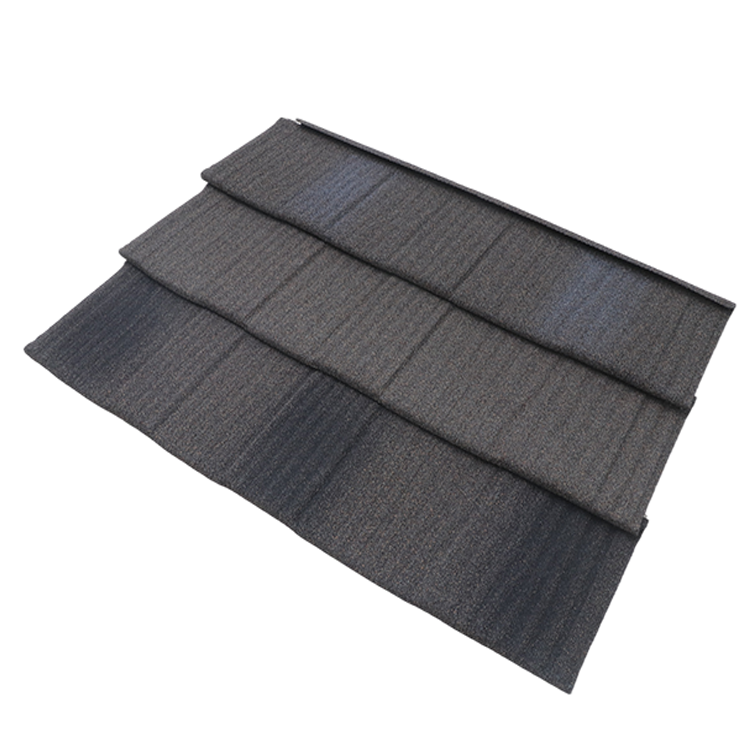
Stone coated steel shingles are slightly heavier than bare steel panels (100–150 lbs per square) due to the stone-chip coating layer — but still a fraction of the weight of asphalt, tile, or slate, while offering the visual profile of shake, shingle, or tile roofing that bare metal panels can’t match. Our own Bond Tile, for example, weighs just 2–3.5kg per piece depending on gauge — a fraction of what an equivalent clay tile would weigh.
So while stone coated steel isn’t technically the single lightest roofing material on the market — bare aluminum and exposed-fastener steel panels both weigh less — it occupies a different, arguably more useful position: the practical middle ground. It’s light enough to install over existing decking (and often directly over old asphalt shingles) in many jurisdictions, while heavy and rigid enough in construction to resist wind uplift and impact damage far better than lightweight aluminum alone. For most residential metal roof replacement projects, that combination matters more than shaving off the last few pounds per square.
Real Numbers From Our Factory Floor
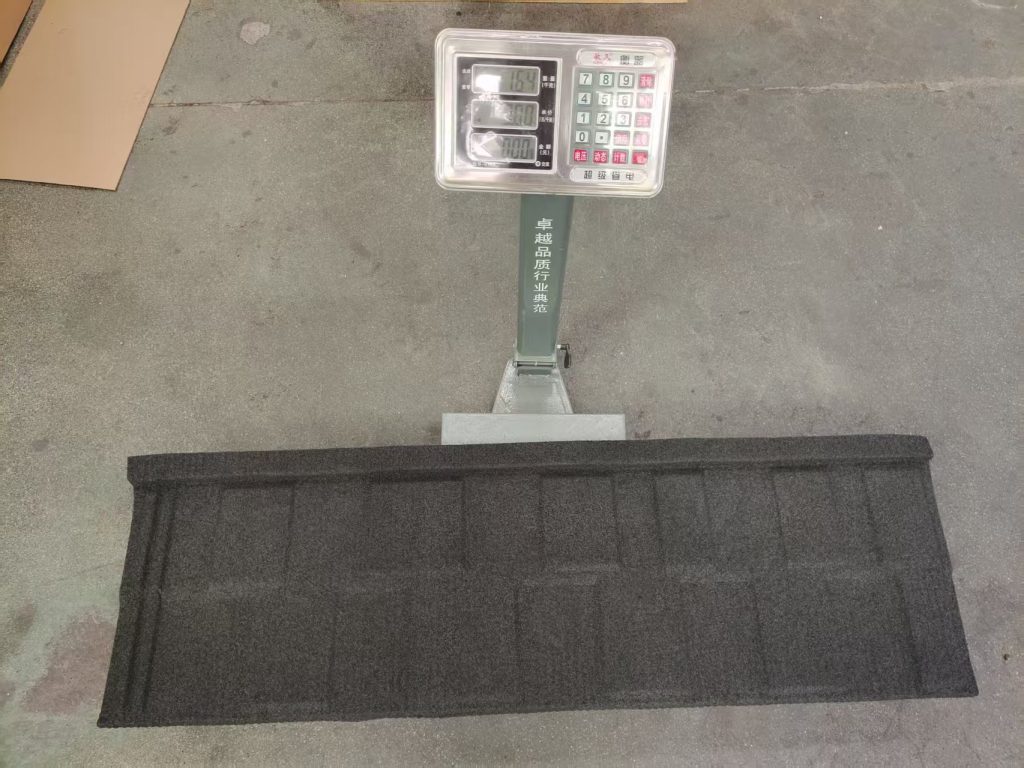
Most articles comparing roofing weight quote industry averages. We’d rather show you our own numbers. Below is a piece straight off our line — a 0.18mm gauge Square (Grid) profile tile, weighed at 1.64kg per piece, one of the lightest gauges we produce:
Because panel weight changes with both steel gauge and tile profile, we keep an internal reference chart for every combination we produce. Here’s the full breakdown, in kilograms per piece, across our standard gauges and profiles:
| Gauge (mm) | Shingle Tile | Bond Tile | Wood Tile | Milano Tile | Classic Tile | Rainbow Arc | Ridge Cap | Ridge Cap Type 2 | Valley Tray | Eave Board | Gable/Barge Board | Flashing | Flat Sheet |
|---|---|---|---|---|---|---|---|---|---|---|---|---|---|
| 0.18 | 1.64 | 1.65 | 1.65 | 1.64 | — | — | — | — | — | — | — | — | 0.20 |
| 0.20 | 1.80 | 1.81 | 1.82 | — | — | — | — | — | — | — | — | — | |
| 0.26 | 2.18 | 2.14 | 2.25 | 2.17 | 2.10 | 2.20 | — | — | — | — | — | — | 3.0 |
| 0.28 | 2.26 | 2.17 | 2.28 | 2.19 | 2.12 | 2.20 | — | — | — | — | — | — | 3.0 |
| 0.30 | 2.33 | 2.32 | 2.31 | 2.27 | 2.29 | 2.21 | 0.40 | 1.49 | 1.49 | 1.49 | 1.70 | 1.00 | 3.2 |
| 0.32 | 2.39 | 2.37 | 2.32 | 2.44 | 2.32 | 2.32 | 0.43 | 1.60 | 1.60 | 1.60 | 1.80 | 1.10 | 3.5 |
| 0.35 | 2.53 | 2.51 | 2.53 | 2.49 | 2.53 | 2.53 | 0.45 | 1.80 | 1.80 | 1.80 | 2.00 | 1.18 | 3.8 |
| 0.38 | 2.70 | 2.63 | 2.76 | 2.72 | 2.65 | 2.62 | 0.48 | 2.10 | 2.10 | 2.10 | 2.22 | 1.27 | 4.1 |
| 0.40 | 2.73 | 2.66 | 2.78 | 2.67 | 2.66 | 2.30 | 0.50 | 2.30 | 2.30 | 2.40 | 1.40 | 4.5 | |
| 0.45 | 3.00 | 2.97 | 3.10 | 3.00 | 2.96 | 2.96 | 0.53 | 2.50 | 2.50 | 2.50 | 2.66 | 1.55 | 5.0 |
| 0.50 | 3.51 | 3.50 | 3.53 | — | — | — | — | — | — | — | — | — | — |
A few things worth pointing out from this table:
- Going from 0.45mm down to 0.20–0.26mm gauge can cut the weight of a single tile by roughly 25–30%, which adds up fast across a full roof — but gauge also affects wind and impact performance, which is why we recommend matching gauge to local wind ratings rather than defaulting to the lightest option available.
- The accessory pieces (ridge caps, valley trays, eave boards, gable/barge boards, flashing) are all significantly lighter than the field tiles themselves, which is worth factoring into total shipment weight and container loading calculations.
- If you’re comparing profiles, our Shingle Tile, Bond Tile, Wood Tile, Milano Tile, and Classic Tile profiles all sit within a similar weight range at a given gauge, so the choice between them usually comes down to architectural style rather than structural load. You can preview all of our profiles and accessory options — including ridge caps, valley trays, and flashing — on our Color & Style Selector.
Comparing the Lightest Roofing Materials on the Market
Beyond metal, several other categories compete for the “lightest roof material” title, particularly for flat or low-slope roofing:
Low slope and flat roofing membranes (TPO, PVC, modified bitumen) are extremely light, often under 50 lbs per square, and are common on commercial roof cladding and additions. However, they are generally unsuitable for pitched residential roofs and typically carry shorter lifespans than metal.
Plastic roof shingles (synthetic polymer shingles designed to mimic slate or shake) are lightweight and impact-resistant, but often cost more than stone coated steel while offering shorter warranty periods.
Light colored roof shingles, including reflective asphalt or “cool roof” shingle products, help reduce heat absorption but don’t reduce structural load compared to standard asphalt.
Among all of these, stone coated steel remains the standout option when a homeowner needs a material that is simultaneously lightweight, long-lasting, wind- and impact-rated, and visually similar to traditional shake, shingle, or tile roofing.
Lightweight Insulating Concrete vs. Lightweight Metal Roofing
Lightweight insulating concrete (LWIC) roof decks are common in commercial construction, valued for their fire resistance and insulation properties on flat or low-slope structures. However, LWIC systems are engineered as a roof deck assembly rather than a finished, weather-exposed surface — they still require a membrane or coating on top, and they are far heavier than a stone coated steel shingle system once fully assembled (typically 200–400+ lbs per square before the finished surface is even added).
For residential, pitched-roof applications — which is where most U.S. homeowners searching for a “lightest roof” solution are focused — stone coated steel shingles offer a simpler, lighter, and often more cost-effective path to a durable, finished roofing surface without the additional deck assembly required by LWIC systems. If you’re weighing a heavier system like LWIC against lightweight metal specifically for a structural load question — say, for an addition rather than a full re-roof — we’ve written more on that decision in Roof Weight and Second Story Additions: The Material Decision That Comes Before the Design.
Why Roof Weight Matters: Structural, Cost, and Installation Benefits
Choosing a lighter roofing material affects more than just the math on a structural engineer’s report:
- Lower structural demand — Lighter materials reduce stress on rafters, trusses, and the overall building structure, which matters for older homes, additions, and structures in seismic zones.
- Overlay installation potential — Many stone coated steel systems are light enough to be installed directly over existing asphalt shingles in eligible projects, cutting both labor time and tear-off/disposal costs.
- Lower shipping and handling costs — For contractors and distributors, lighter material means lower freight costs per square, which matters significantly for exporters and wholesale roofing suppliers moving product across the country or internationally. We’ll walk through exactly how much this can matter in the case study below.
- Faster installation — Lighter panels are easier and safer for roofing crews to handle, often shortening project timelines compared with heavy tile, slate, or concrete systems.
- Wind and seismic performance — Counterintuitively, lighter isn’t always weaker: modern stone coated steel panels are engineered with high wind uplift ratings and impact resistance that heavier, more brittle materials like clay tile often can’t match. We go deeper into the physics behind this in Light Roof, Strong Roof: Debunking the “Heavier Is Sturdier” Myth.
Case Study: Helping a Manila-Based Distributor Switch from Ceramic to Stone Coated Steel
A building materials distributor based in Manila, Philippines came to us looking to add roofing to his product line. He was torn between ceramic tile and stone coated metal tile — and given that Manila sees frequent typhoons and heavy seasonal rain, he needed a roof that could genuinely hold up, not just look good on paper.
The deciding factor ended up being weight, and the math was straightforward once we laid it out: loading a standard 20GP container from China with ceramic tile — at roughly 40kg per square meter — fits about 700 square meters of usable roofing material per container. Loading the same container with our 0.4mm stone coated steel tile — at roughly 6kg per square meter — fits closer to 4,700 square meters. That’s nearly seven times more roofing area per container, which directly cuts his landed cost per square meter and installation labor cost, while giving him meaningfully more margin to work with as a distributor.
He ultimately chose our interlocking (lock-joint) stone coated steel system, which gave him the lightweight shipping and installation advantage he needed without compromising on typhoon resistance — backed by our 40-year warranty on the AZ150-grade coating tier. You can see the full warranty structure by coating grade on our Warranty & Certificates page.
Stone Coated Steel Roofing: The Lightest Durable Option for the U.S. Market
Stone coated steel roofing occupies a unique position in the roofing materials market: light enough to solve the structural and installation challenges that drive people to search for “lightest roof material,” while durable enough to carry up to 40-year factory warranties on our highest coating grade, Class 4 impact ratings, and high wind-resistance certifications.
Unlike raw aluminum or exposed-fastener steel panels, stone coated systems also address the aesthetic concerns that come up in searches like “roof tile types” and “durable roofing materials” — offering shake, shingle, and tile profiles in a wide range of colors, including reflective light-toned finishes that support “cooler roof” performance by reducing attic heat gain in hot climates.
For homeowners specifically comparing “best roofing material” options, stone coated steel typically wins on the combination of factors that matter most over a 20–30 year ownership period: weight, wind/impact durability, fire resistance, and total lifecycle cost versus repeated asphalt replacements.
Cost Considerations and Sourcing
Stone coated metal shingles typically install for $9–$14 per square foot in the U.S. market — higher than asphalt shingles ($4.50–$7.50 per square foot) but lower than natural slate or clay tile ($15–$30+ per square foot), while offering a fraction of the weight of both heavier alternatives. That installed price reflects the full retail supply chain: material, freight, warehousing, contractor labor, and margin at each stage.
For distributors, contractors, and importers sourcing panels directly from the factory, the underlying material economics look very different — and as the Manila case above shows, panel weight directly affects how much usable roofing area fits in a single container, which is often a bigger lever on total landed cost than the per-unit material price itself. If you’re evaluating sourcing for a project or wholesale order, you can request current factory-direct pricing and free samples here.
Choosing the Right Manufacturer for Lightweight Stone Coated Roofing
Not all stone coated steel products are engineered equally, and panel weight can vary noticeably between manufacturers depending on the steel gauge used and the thickness of the stone-chip coating. When comparing suppliers — whether for a single residential project or a bulk wholesale order — it’s worth confirming a few details beyond price:
- Steel gauge and coating weight — Thinner gauges reduce shipping weight but can affect long-term wind and impact performance; ask for documented test data rather than relying on marketing claims alone.
- Panel coverage per unit — Larger interlocking panels reduce the number of fasteners and joints, which can improve both installation speed and weather-tightness.
- Third-party certifications — UL, ASTM, and regional wind/impact approvals (such as Miami-Dade or Florida Building Code) confirm that a lighter panel hasn’t sacrificed structural performance.
- Freight and packaging efficiency — For contractors and distributors ordering at scale, a manufacturer that optimizes pallet weight and container loading can meaningfully reduce landed cost per square, on top of the material’s inherent lightweight advantage.
For exporters and importers evaluating stone coated steel roofing at scale, these manufacturing details — not just the finished weight per square — ultimately determine whether “lightweight” translates into real savings across an entire project or shipment.
What is the lightest roofing material available?
Among finished, weather-resistant roofing surfaces, aluminum panels and stone coated steel shingles are among the lightest options, typically 40–150 lbs per square, compared to 200–1,500+ lbs per square for asphalt, tile, or slate.
Is a lighter roof always cheaper to install?
Not necessarily on material cost alone, but lighter materials often reduce structural reinforcement needs, labor time, and — in eligible overlay installations — tear-off costs, which can lower total project cost.
Can stone coated steel shingles be installed on an older home?
In many cases, yes. Their relatively light weight compared to tile, slate, or thick concrete systems makes them a common choice for structures where load capacity is a concern, though a structural assessment is always recommended for older homes.
Are lightweight roofs less durable than heavier ones?
Not with modern stone coated steel systems. Engineering advances in panel design and interlocking systems allow lightweight metal roofing to meet or exceed the wind, impact, and fire performance of much heavier traditional materials.
How much does a stone coated steel roof weigh in total for an average home?
For a typical 2,000–2,500 sq ft roof (20–25 squares), a stone coated steel system adds up to roughly 2,500–3,125 lbs total, compared to about 6,000–7,500 lbs for asphalt shingles and 17,000–21,000+ lbs for clay or concrete tile on the same footprint. That difference is often the deciding factor for older homes or additions where the structural engineer’s report is the real constraint, not personal preference.
Does a lighter roof mean less reinforcement is needed for solar panels?
Often, yes. Since a stone coated steel roof already carries a fraction of the dead load of tile or slate, there’s typically more of the structure’s total load capacity available for a solar array on top of it — which can simplify or reduce the extent of structural reinforcement needed compared to adding solar to a heavier roofing system.
Can stone coated steel roofing be installed over existing asphalt shingles?
In many jurisdictions and for many projects, yes — its light weight is exactly what makes overlay installation possible in the first place, since the combined weight of the old shingle layer and the new panel system still typically stays well under what a single layer of tile or slate would weigh. Local code and an existing-roof condition assessment should always confirm eligibility before proceeding.
How does stone coated steel compare in weight to standing seam metal roofing?
Bare standing seam panels are usually lighter than stone coated steel, generally in the 50–100 lbs per square range, since they don’t carry the additional stone-chip coating layer. The trade-off is aesthetic and functional: standing seam has a smooth, industrial look and no granulated surface, while stone coated steel’s slightly higher weight buys a textured, shingle- or tile-like appearance along with the coating’s added UV and impact protection.
Is stone coated steel roofing suitable for manufactured or mobile homes?
It can be, but weight limits on manufactured and mobile home structures are often stricter than site-built homes, and many of these structures are originally designed around very lightweight roofing materials. Stone coated steel is dramatically lighter than tile or slate, but it’s still heavier than the ultra-lightweight materials some manufactured homes are engineered for — so a structural check with the home’s manufacturer or a qualified engineer is essential before specifying it on this type of structure.
Final Thoughts
When homeowners and contractors search for the lightest roof material, they’re usually trying to solve a structural or logistical problem without compromising on durability or appearance. Stone coated steel roofing answers that need directly — combining a weight profile close to bare aluminum panels with the durability, wind resistance, and traditional shake, shingle, or tile aesthetics that heavier materials like asphalt, concrete, and slate simply can’t match at a comparable weight. For anyone comparing lightweight roofing options for a U.S. residential or commercial project, stone coated steel deserves a place at the top of the shortlist.